
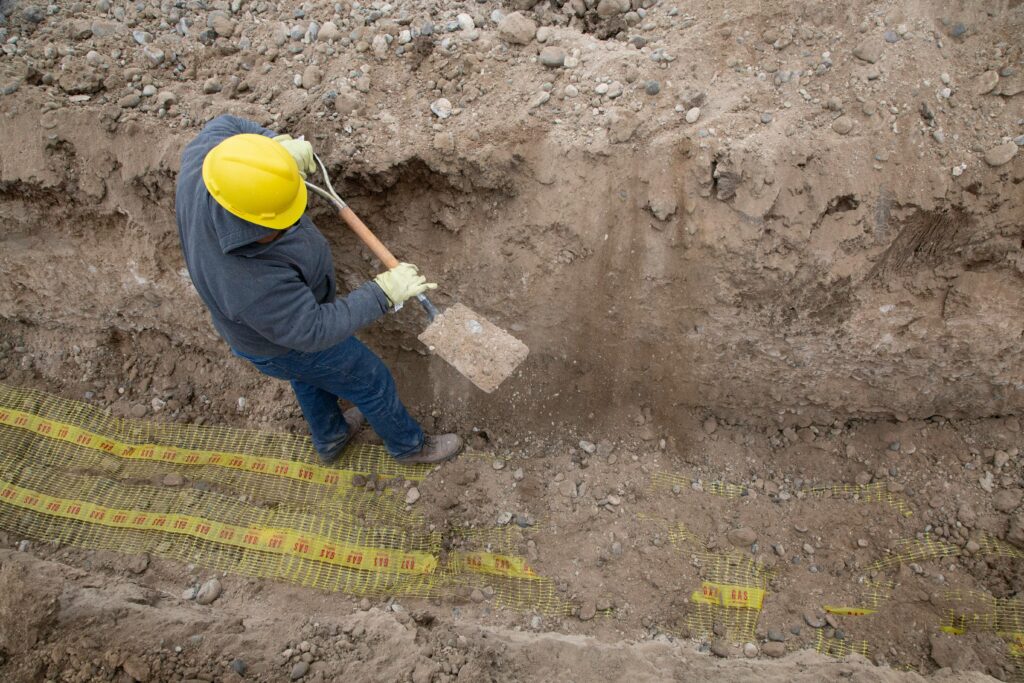
A cubic yard of soil weighs close to a ton. During a trench or excavation collapse accident, that soil does not fall gradually. It moves fast. A worker buried to the waist by even a partial trench wall failure can suffocate within minutes. That’s where a Trench Collapse Accident Lawyer can help.
The surrounding soil prevents the chest from expanding. Full burial is almost always fatal without rapid, technically specialized rescue. OSHA treats unprotected trenches as an imminently dangerous condition requiring immediate abatement. The risk is not theoretical. The consequences of a single failure are final. If you’ve been injured in a trench collapse, call an experienced construction injury lawyer today.
Despite this, trench accidents continue to happen on New York City construction sites. They happen almost always because someone made an economic or scheduling decision to skip or shortcut the protective systems that OSHA and the New York Industrial Code require.
If you were injured in a trench or excavation accident in New York, you have legal rights. But it requires understanding some important distinctions that are specific to excavation cases. The Dearie Law Firm, P.C. has represented workers injured in trench collapses and excavation accidents for more than 35 years.
For a broader overview of trench and excavation accident claims, safety failures, responsible parties, injuries, and compensation, visit our New York City Trench And Excavation Accident Lawyer page.
Trench Collapse Accident Lawyer: What Do They Do?
Labor Law § 240(1) protects workers from gravity-related construction injuries. Most people familiar with the statute think of it in terms of falls from height. A worker falling off a scaffold or from a ladder. But the statute also covers falls from one elevation to another. This is where trench cases become legally interesting. And contested.
When a worker falls into an unprotected trench or excavation opening, New York courts have generally held that § 240(1) applies. The fall is from one elevation to a lower one. The statute’s requirement of adequate protection against falls from heights applies to floor openings and excavation openings in the same way it applies to scaffold edges. A trench that lacked adequate covers, barriers, or guardrails at its edges, and into which a worker fell, is a § 240 case.
But when the accident mechanism is different, the § 240 analysis changes. When the trench walls collapse onto a worker who was already inside the trench working, courts have disagreed. Is a cave-in onto a worker inside a trench a “falling object” claim under § 240? Or does it fall outside the statute’s scope entirely?
Some courts have held that soil that collapses laterally rather than vertically is not a “falling object” triggering § 240. Others have analyzed the specific mechanics of the collapse and found § 240 applicable. This is genuinely contested territory. The outcome often depends on the specific facts of how the collapse occurred.
What this means practically: a trench accident attorney must analyze the specific mechanics of your accident. Did you fall into the trench, or did the trench collapse around you? In what direction did the soil move? The answers determine whether § 240 is available. The answer matters significantly for the strength of the legal claim.
Labor Law § 241(6) and the Industrial Code’s Excavation Requirements
Regardless of how the § 240 analysis resolves, Labor Law § 241(6) provides a robust separate claim for trench accidents based on violations of the New York Industrial Code. The Industrial Code contains detailed requirements for excavation safety. These requirements are more specific than OSHA’s federal standard in some respects.
23 NYCRR § 23-4.1 through § 23-4.5 set out comprehensive requirements for excavation safety. These include mandatory soil classification by a competent person. They include requirements for sloping, shoring, and sheeting systems based on soil type and excavation depth. They include specific provisions for excavations adjacent to existing structures.
23 NYCRR § 23-4.2 specifically governs shoring and sheeting requirements. It mandates that all excavations in which workers are required to work below grade be adequately shored or sheeted where the vertical sides exceed five feet. The only exception is when the entire excavation is in solid rock.
23 NYCRR § 23-4.4 governs inspection requirements. It mandates that a competent person inspect excavations before workers enter each day and after any rain, frost thaw, vibration event, or other condition that could have affected the excavation’s stability.
Violations of any of these specific provisions that proximately caused the accident create liability under § 241(6). Unlike § 240, § 241(6) is not a strict liability statute. But the Industrial Code’s specificity gives plaintiffs a wide range of specific provisions to point to. Violations in trench cases are common. The protections that NYCRR requires are expensive and time-consuming to install. They are frequently skipped under schedule pressure.
Soil Classification Failures: The Most Litigated Issue in Trench Cases
OSHA’s excavation standard and the New York Industrial Code both require a “competent person” to classify soil before excavation work begins. The classification must happen before workers enter the excavation. Soil classification determines what protective system is required.
The classification determines whether the soil is stable rock, Type A, Type B, or Type C. Type C is the most unstable. Type A soil may allow for less aggressive sloping. Type C soil requires either very wide sloping or full shoring/sheeting.
In practice, soil classification is frequently done incorrectly or not done at all. Supervisors eyeball the soil. They make judgment calls based on cost and schedule. They ignore the visual and manual tests the standard requires.
When a trench collapses in what was classified (or assumed to be) Type A soil, the immediate factual question is: was that classification accurate? Obtaining soil samples, reviewing the site’s geological history, and examining the original classification documentation are key early steps in excavation accident investigation.
Water, Vibration, and Adjacent Structures: The Environmental Factors Most Often Ignored
Three environmental factors are responsible for a disproportionate share of unexpected trench failures in New York City.
Water infiltration destabilizes soil cohesion rapidly. A trench that was stable when excavation began can become dangerously unstable within hours of a rainstorm or a broken water main. The Industrial Code’s inspection requirements specifically address this. Excavations must be re-inspected after rain events. Failures to re-inspect after rain that preceded a collapse are a common and significant negligence finding.
Vibration from nearby equipment, subway lines, or traffic creates cyclic stress in trench walls. This can trigger failure even in soil that would otherwise be stable. New York City’s geology makes vibration-induced failure a real and recurring risk. Subway tunnels. Utility corridors. Heavy street traffic. Construction equipment on adjacent sites.
Adjacent structures create surcharge loads. Concentrated weight near the trench edge increases lateral earth pressure against the trench walls. Buildings, parked equipment, and material stockpiles near trench edges are all prohibited at certain distances without engineering analysis. Violations of these setback requirements are another common § 241(6) violation in trench collapse cases.
How a Trench Collapse Accident Lawyer Can Help
Unlike fall-from-height cases, where the physical evidence often survives the accident intact, trench accidents typically alter or destroy their own evidence. The collapsed trench is immediately excavated by rescue personnel. The specific wall configuration that failed disappears within minutes.
This makes witness evidence critically important. Workers who observed the trench before and during the collapse are key. Pre-accident photographs are essential. Any soil classification documentation is essential. The excavation plan prepared before work began is essential.
A Trench Collapse Accident Lawyer handling a trench case should also immediately obtain the OSHA inspection report. In serious injury cases, this report will typically be completed within days. It will document the specific code violations OSHA found during its post-accident inspection.
Contact a Trench Collapse Accident Lawyer at The Dearie Law Firm for a Free Case Review
If you were injured in a trench or excavation accident in New York, learn how our New York trench and excavation accident lawyers can help, then call The Dearie Law Firm, P.C. at (212) 970-6500 for a free consultation. The specific mechanics of your accident determine which legal theories apply and what your case is worth. How the collapse occurred. What the soil conditions were. What protections were or were not in place. We handle these cases on contingency. No fee unless we recover for you.