
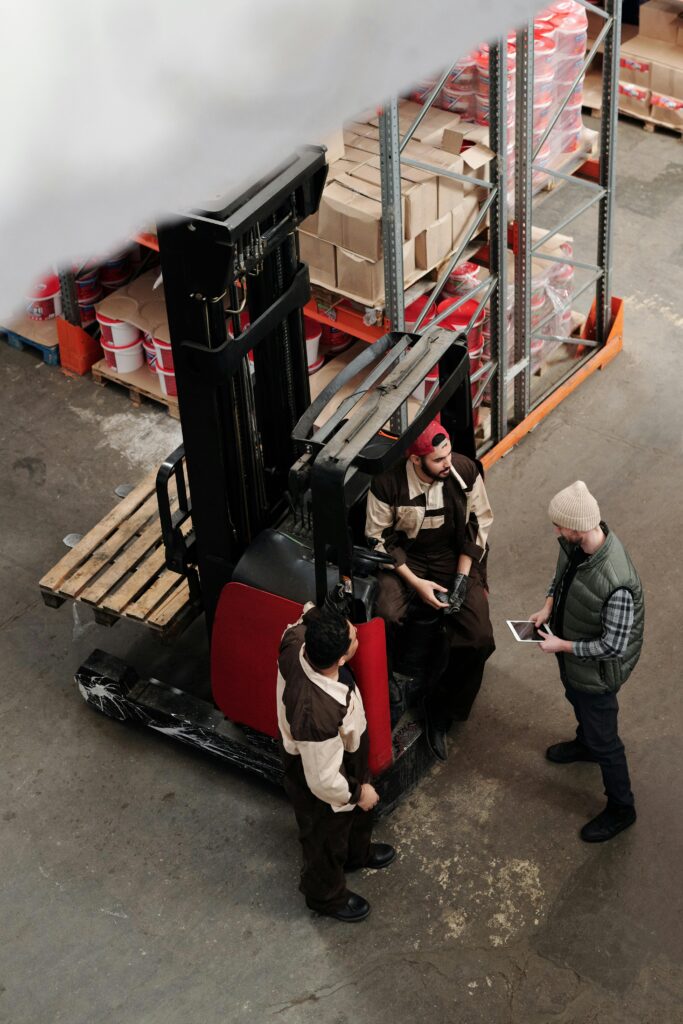
Forklift Accidents on New York Construction Sites: Legal Claims and Who Is Liable
A loaded forklift can weigh 9,000 pounds or more before the load is added. That machine is steered by its rear wheels, not its front. It can turn within its own length. This means its rear end swings outward sharply during turns. It can pin a worker against a wall, a vehicle, or another piece of equipment without the operator ever seeing the collision coming. If a forklift accident caused you injury, call a Forklift Injury Lawyer today.
Add to this the severely limited forward visibility when carrying a raised load and uneven surfaces of an active construction site. Add the pressure to move materials quickly in a compressed work schedule. The conditions for a forklift accident are present on almost every large job site, almost every day.
Forklift accidents produce some of the most catastrophic injury profiles in construction. Crush injuries to the lower extremities when a worker is run over. Traumatic amputations when a limb is caught between the forklift and a fixed object. Fatal struck-by injuries when a load drops or the machine tips.
The Dearie Law Firm, P.C. has represented workers seriously injured in forklift accidents on New York construction sites for more than 35 years.
How § 240(1) Applies to Forklift Accidents — and Where It Doesn’t
Labor Law § 240(1) applies to gravity-related construction injuries. Falls from height. Workers struck by falling objects. Forklift accidents create both scenarios. But they create them in ways that require specific legal analysis.
When a load falls from elevated forks and strikes a worker below, the § 240 falling-object analysis applies directly. The key question under Court of Appeals precedent is whether the load fell because an adequate elevation-related safety device was absent.
In the forklift context, the applicable safety devices are the load backrest extension (which prevents the load from sliding back toward the operator), the proper forks for the load’s width and center of gravity, and the tilt mechanism used correctly to stabilize the load during travel. A load that falls because the forks were wrong for the load configuration, or because the tilt was not applied, or because the load was stacked beyond the backrest’s containment capacity creates equipment failures that satisfy § 240’s requirement of an inadequate safety device.
But when the injury mechanism is the forklift itself striking a worker, § 240 does not apply. Run-overs. Pinnings. Rear-swing collisions. These are not gravity-related injuries in the sense the statute addresses.
The applicable theories for these injuries are § 241(6) (Industrial Code violations governing powered industrial truck operations and pedestrian traffic management on job sites) and § 200 / direct negligence (failure to implement adequate separation between forklift travel paths and pedestrian work areas). Understanding which theory applies to your accident determines the liability standard and the available defenses.
The Industrial Code Requirements for Forklift Operations That Are Most Frequently Violated
23 NYCRR § 23-9.8 governs the use of industrial trucks, including forklifts, on construction sites in New York. This provision, combined with OSHA’s powered industrial trucks standard (29 CFR 1926.602), creates a specific set of operational requirements. Violations of these requirements are commonly found in forklift accident cases.
Operator certification: OSHA requires employers to certify each operator for the specific type of truck they operate. It requires evaluation of each operator’s performance. Forklift operator certification records are among the first documents to obtain in a forklift accident case. The absence of certification records is equally important. Failure to train or certify is a § 241(6) violation and direct negligence.
Pedestrian traffic control: OSHA’s standard requires that pedestrian traffic and forklift travel be separated where both occur in the same area. The standard calls for physical barriers, designated travel lanes, and warning systems. On a construction site where workers on foot share the same space as operating forklifts (which is common), the failure to establish adequate separation is a frequent violation.
Capacity and load stability: The requirement to operate within the rated capacity and to use proper attachments and load configurations is explicitly required under both OSHA and the Industrial Code. Overloading and improper load configuration are both common violations in falling-load cases.
Pre-shift inspection: Both OSHA and the Industrial Code require documented daily inspection of forklifts before operation. Inspection records are important evidence. The absence of inspection records is equally important. They reveal whether known mechanical deficiencies were addressed.
Cross-Employer Liability: The Scenario Forklift Cases Most Often Involve
New York construction sites are multi-employer workplaces. Forklift accidents very commonly involve a worker from one employer being injured by a forklift operated by a worker from a completely different employer.
This cross-employer scenario is legally significant. It bypasses the workers’ compensation bar entirely with respect to the forklift operator’s employer.
When a concrete subcontractor’s worker is struck by a forklift operated by a masonry subcontractor’s worker, the concrete worker cannot sue their own employer. But the masonry subcontractor is not their employer. A direct negligence action against the masonry subcontractor and its operator is fully available. This is often the most direct and strongest claim in a multi-employer forklift case. It runs parallel to the Labor Law claims against the general contractor and property owner.
The important evidentiary question in cross-employer cases is establishing which company employed the forklift operator at the time of the accident. Contract documents, payroll records, and site sign-in logs from the date of the accident are the primary sources for establishing this employment relationship. They should be obtained and preserved early in the investigation.
Forklift Tip-Over Cases: A Different Analysis
When a forklift tips over, the primary injury victim is often the operator themselves. Tip-overs typically happen because the forklift was operated on an inadequately rated surface. Or overloaded. Or turned at speed with a raised load.
Forklift rollover protection structures (ROPS) are required on many forklift types. The failure to provide or maintain adequate ROPS can create product liability against the manufacturer. It can also create negligence liability against the employer who assigned the operator to an inadequately equipped machine.
The analysis in tip-over cases involving the operator as victim focuses on whether the machine was appropriate for the terrain and load conditions of the specific job. This requires inspection of both the machine’s specifications and the site conditions where the tip-over occurred.
Contact The Dearie Law Firm for a Free Case Review
If you were injured in a forklift accident on a New York construction site, the specific facts of how the accident happened determine which legal theories apply and how strong each is. Call The Dearie Law Firm, P.C. for a free consultation. We handle these cases on contingency. No fee unless we recover for you.