
The Dearie Law Firm, P.C. has recovered over $400 million for injury victims across New York City — including NYCHA tenants hurt by negligence and disrepair.
If you were injured in a NYCHA building, our attorneys can review your case, protect your 90-day Notice of Claim deadline, and fight for the compensation you deserve.
Were You Injured On New York City Housing Authority Property?
If you were injured because of a dangerous condition in a New York City Housing Authority building or development, you may have the right to seek compensation. Tenants, guests, delivery workers, contractors, and other visitors can suffer serious injuries when unsafe conditions are not repaired or properly addressed.
A NYCHA injury claim may involve a defective elevator, broken staircase, ceiling collapse, unsafe walkway, inadequate lighting, negligent security, falling debris, fire, explosion, or another hazardous condition.
Claims involving NYCHA have special procedures and short deadlines. In many cases, a Notice of Claim must be served within 90 days of the accident. Contacting a NYCHA injury attorney promptly can help preserve evidence, identify the responsible parties, and protect your legal rights.
Call (212) 970-6500 or contact The Dearie Law Firm for a free consultation.
NYCHA Injury Cases We Handle
The Dearie Law Firm represents people injured in NYCHA buildings, apartments, grounds, and common areas. These cases may involve:
Ceiling collapses and falling plaster
Defective, misleveling, or rapidly moving elevators
Broken stairs, railings, and handrails
Slippery stairwells, hallways, and entrance areas
Cracked or uneven sidewalks and walkways
Water, debris, snow, or ice left in walking areas
Poor lighting in stairwells and common areas
Unsafe doors, locks, gates, and intercom systems
Negligent security and foreseeable assaults
Fires, explosions, smoke inhalation, and burn injuries
Hot water, steam, boiler, and radiator accidents
Falling fixtures, masonry, and building materials
Unsafe playgrounds, courtyards, and outdoor areas
Visit our NYCHA Injury Resource Hub to browse additional guides by hazard, borough, and housing development.
When NYCHA May Be Responsible For An Injury
NYCHA has a responsibility to maintain its property in a reasonably safe condition. A negligence claim may depend on evidence that NYCHA created the dangerous condition, received notice of it, or should have discovered it through reasonable inspection and maintenance.
Evidence of notice may include prior repair requests, complaints from residents, work orders, inspection records, maintenance logs, photographs, surveillance footage, witness statements, and evidence showing how long the condition existed.
Some accidents may also involve contractors, elevator companies, security companies, maintenance vendors, utility companies, or other parties. A complete investigation should identify every person or company that may have contributed to the accident.
Read more about landlord liability for dangerous conditions in an apartment building.
Deadlines For A NYCHA Injury Claim
A claim against NYCHA is different from an ordinary personal injury claim against a private property owner.
Under New York law, a Notice of Claim generally must be served within 90 days after the claim arises. NYCHA may then request testimony and other information about the accident through an examination commonly called a 50-h hearing.
Different filing deadlines may apply depending on the type of case, the age of the injured person, whether the accident was fatal, and other circumstances. Do not assume that you have the ordinary deadline that applies to a claim against a private landlord.
Review our guide to the New York City Notice of Claim deadline and our explanation of the process for filing a personal injury lawsuit against NYCHA.
You can also review New York General Municipal Law § 50-e and General Municipal Law § 50-h.
Do not wait until the end of the 90-day period. A lawyer should have time to investigate the accident, identify the correct location and parties, and prepare the Notice of Claim accurately.
What To Do After An Accident On NYCHA Property
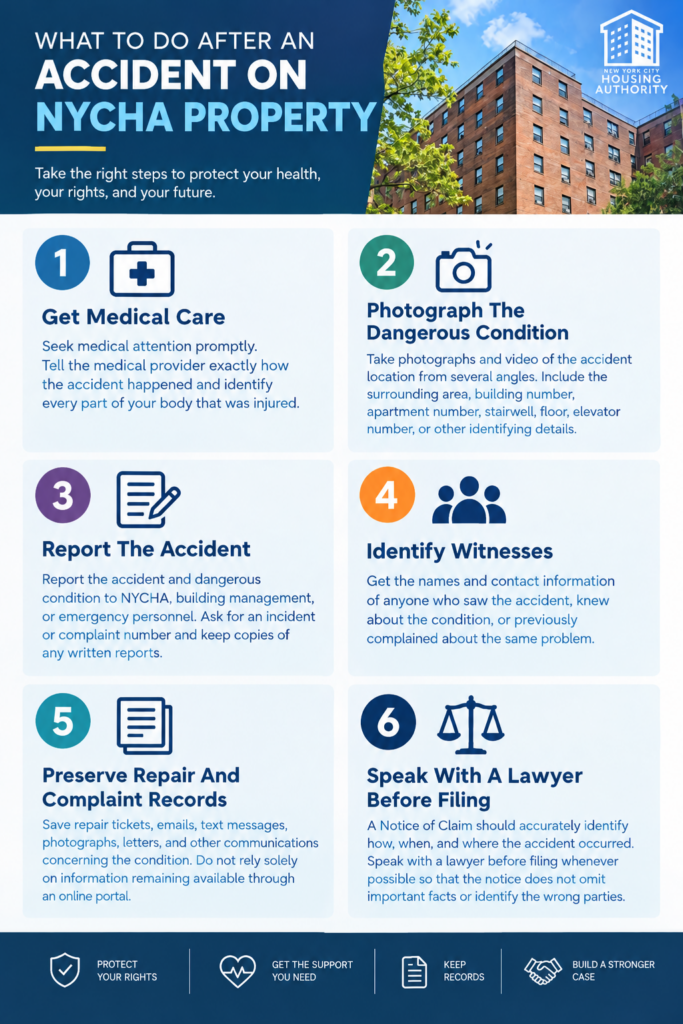
Evidence That May Support A NYCHA Injury Claim
Relevant evidence may include:
-
- Photographs and video of the dangerous condition
-
- NYCHA complaint and repair records
-
- Work orders and maintenance logs
-
- Elevator service and inspection records
-
- Building inspection and violation records
-
- Surveillance footage
-
- Incident and police reports
-
- Witness statements
-
- Emails, letters, and text messages
-
- Medical records and diagnostic testing
-
- Employment and wage records
Conditions can be repaired, cleaned, removed, or changed shortly after an accident. Early documentation can become critical when NYCHA or another party later disputes what happened.
Compensation In A NYCHA Injury Case
Depending on the facts and severity of the injuries, a claim may seek compensation for:
-
- Past and future pain and suffering
-
- Medical expenses
-
- Lost wages and employment benefits
-
- Reduced future earning capacity
-
- Rehabilitation and therapy
-
- Future medical treatment and surgery
-
- Scarring and disfigurement
-
- Loss of enjoyment of life
-
- Wrongful death damages when an accident is fatal
The compensation available depends on the injuries, evidence, responsible parties, and long-term effect of the accident.
How A NYCHA Injury Lawyer Can Help
Our investigation may include:
-
- Identifying the correct NYCHA development, building, and accident location
-
- Preparing and serving the Notice of Claim
-
- Preserving photographs, video, records, and physical evidence
-
- Obtaining repair requests, work orders, and maintenance records
-
- Investigating prior complaints and similar incidents
-
- Identifying contractors and other responsible parties
-
- Preparing the client for a 50-h hearing
-
- Documenting the full effect of the injuries
-
- Negotiating with insurers and defense attorneys
-
- Filing a lawsuit when appropriate
Learn more about how a NYCHA accident lawyer can help pursue compensation.
Frequently Asked Questions About NYCHA Injury Claims
Can A NYCHA Tenant File An Injury Claim?
Yes. A tenant may have a claim when NYCHA negligence causes an injury. Guests, delivery workers, contractors, and other lawful visitors may also have claims depending on the circumstances.
What If NYCHA Says It Did Not Know About The Condition?
Actual notice is not the only issue. A claim may also depend on whether the condition existed long enough that reasonable inspection and maintenance should have discovered it.
What If I Do Not Have A Witness?
A claim does not necessarily require an eyewitness. Photographs, medical records, repair requests, surveillance footage, maintenance records, and evidence of prior complaints may help establish what happened.
What If I Was Injured In A NYCHA Elevator?
Elevator cases may involve NYCHA, an elevator maintenance company, a repair contractor, or another party. Maintenance logs, inspection records, prior service calls, and evidence of earlier malfunctions should be preserved. carefully.
What If More Than 90 Days Have Passed?
Contact a lawyer immediately. In some circumstances, a court may permit a late Notice of Claim, but permission is not automatic and delay can make the case more difficult.
Read more about whether you can sue for an injury caused by NYCHA negligence.
Speak With A New York City NYCHA Injury Lawyer
The Dearie Law Firm represents people injured because of dangerous conditions in NYCHA buildings and developments throughout New York City.
Call (212) 970-6500 or contact The Dearie Law Firm for a free consultation.